

Working from home with a Rottweiler
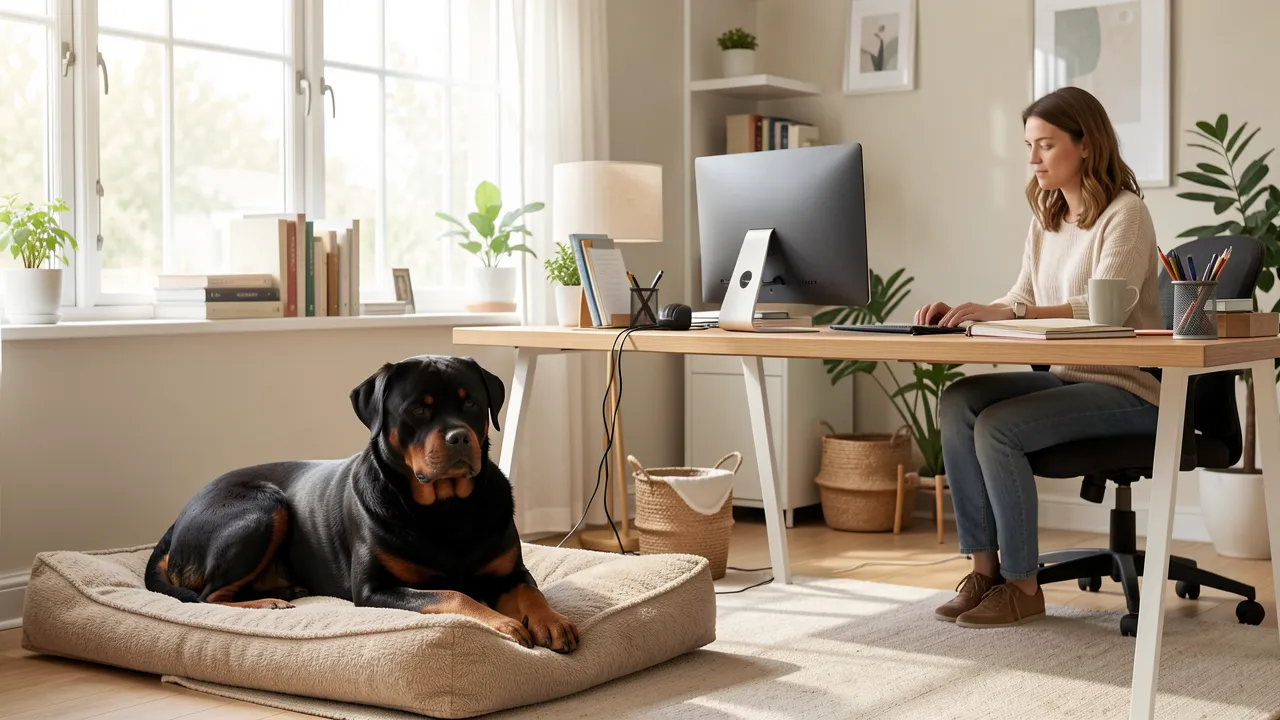
Working from home with a Rottweiler can be deeply rewarding, but it asks for more than placing a bed beside your desk. This powerful, loyal breed was developed for demanding work involving livestock, protection and close cooperation with people. When your remote-work schedule provides clear boundaries, physical activity and calm guidance, your dog can settle into the household rhythm without turning every sound at the door into an event.
A structured morning prepares your Rottweiler for the workday
A Rottweiler usually benefits from knowing what happens next. Before opening your laptop, give your dog a purposeful morning routine: a toilet break, a brisk walk, some basic obedience practice and breakfast. The goal is not simply to tire the dog out, but to meet its need for movement, contact and mental engagement before a quieter period indoors.
For background on breed character, exercise and everyday care, rottweiler dog offers information focused on this German working breed. Rottweilers are often devoted to their household, observant around unfamiliar people and highly responsive to consistent handling. Their protective heritage calls for thoughtful socialisation and supervision, rather than alarm or harsh treatment. A stable, well-raised Rottweiler can be affectionate, calm and reliable in the home.
The amount of exercise varies with age, health and temperament. A young adult may need a substantial walk, controlled play, scent work and short training sessions each day. Puppies should not be pushed through long forced walks or repetitive high-impact activity, since their joints are still developing. Older dogs may prefer several moderate outings and low-impact enrichment.
A useful morning pattern could include:
- A 30 to 45-minute walk with time to sniff.
- Five minutes of recall, loose-lead walking or place training.
- Breakfast delivered through a puzzle feeder or scatter feeding.
- A quiet transition into the home workspace.
Predictable routines reduce uncertainty for a dog that is naturally attentive to its environment. They also help you begin work without responding to pent-up energy every twenty minutes.
Your workspace can support rest without isolating the dog
A remote workspace needs a clear division between your professional activity and your dog’s living area. Your Rottweiler does not need constant interaction while you answer emails or attend video calls. In fact, learning to rest nearby is a valuable skill, particularly for a large breed that may otherwise follow you from room to room.
Set up a comfortable resting zone away from the front door and the busiest household route. A supportive bed, fresh water and a safe chew can make this area appealing. If your dog is accustomed to a crate and enters it willingly, it may also serve as a quiet retreat, but it should never become a punishment or a place for prolonged confinement.
Boundaries should be consistent and easy to understand
Use a baby gate, closed office door or designated mat to define where the dog can settle during concentrated work periods. Teach a “go to bed” or “place” cue in short, positive sessions, then reward calm lying down. Begin when there are few distractions, rather than attempting the lesson during a delivery or a noisy meeting.
The following comparison can help you arrange the space around the dog’s needs.
| Home area | Best use | What to avoid |
|---|---|---|
| Office corner | Quiet bed, water, supervised chew | Positioning beside a window facing passers-by |
| Hallway or entrance | Brief, controlled movement through the home | Leaving the dog unsupervised when visitors arrive |
| Separate room | Rest during calls or deliveries | Using isolation as a response to normal excitement |
| Garden or outdoor area | Supervised breaks, scent games, training | Treating garden access as the day’s only exercise |
Mental activity matters as much as physical exercise. Rotate food toys, hide treats for a short scent search, or practise calm obedience between meetings. A ten-minute scent game can be more satisfying than repeatedly throwing a ball in the garden. Choose activities that encourage thinking and self-control, rather than raising arousal immediately before a conference call.
Doorstep routines prevent guarding habits from growing
Visitors, couriers and maintenance workers can be challenging for a Rottweiler because the door combines unfamiliar people, sudden sounds and a clear boundary around the home. Barking once or twice is not automatically a problem. Repeated rushing, lunging, growling or refusing to disengage requires a management plan before the behaviour becomes rehearsed.
When you expect a delivery, place your dog behind a closed internal door, sturdy gate or in a separate room with an enrichment item before opening the front door. Ask couriers to leave parcels at a safe point if direct contact is unnecessary. Avoid asking strangers to greet the dog through a narrow doorway, where pressure and excitement can rise quickly.
Do not punish warning signals such as growling. A growl communicates discomfort and gives you useful information. Instead, increase distance, secure the environment and seek qualified behavioural support if the reaction is frequent, intense or escalating.
Socialisation means calm exposure, not forced greetings
A well-socialised Rottweiler does not need to adore every visitor. The practical aim is a dog that can notice unfamiliar people, remain manageable and return to calm behaviour. Invite trusted guests one at a time, provide clear instructions and keep early visits short.
You might ask a guest to ignore the dog at first, sit down calmly and avoid leaning over its head. Keep the dog on a lead or behind a gate if that allows everyone to relax. Reward your Rottweiler for choosing to settle, looking away from the guest or responding to your cue. Never rely on size, strength or a reputation for guarding to control a situation.
Children and visitors should not be left unsupervised with any large dog, including a familiar family pet. Responsible ownership means planning for ordinary interruptions, from parcel deliveries to unexpected repair appointments.
A balanced remote-work routine benefits both you and your dog
Your Rottweiler does not need to participate in every part of your working day. It needs dependable care, suitable activity, kind training and safe limits around people entering the home. By meeting those needs before and after focused work sessions, you can create a household routine that respects both your professional responsibilities and your dog’s welfare.
- Give your Rottweiler exercise and training before prolonged desk time.
- Create a quiet resting area away from doors, windows and busy walkways.
- Use food puzzles, scent work and short obedience sessions to prevent boredom.
- Manage deliveries before opening the door, rather than reacting after barking begins.
- Build visitor confidence gradually, with distance, supervision and positive reinforcement.
- Seek a qualified trainer or behaviour professional when guarding behaviour becomes difficult to manage.